Respirable cotton and fibre dust
Blowroom, carding and combing operations release fine vegetable dust that drives byssinosis and chronic airflow obstruction, detectable on spirometry well before a worker reports chest tightness.
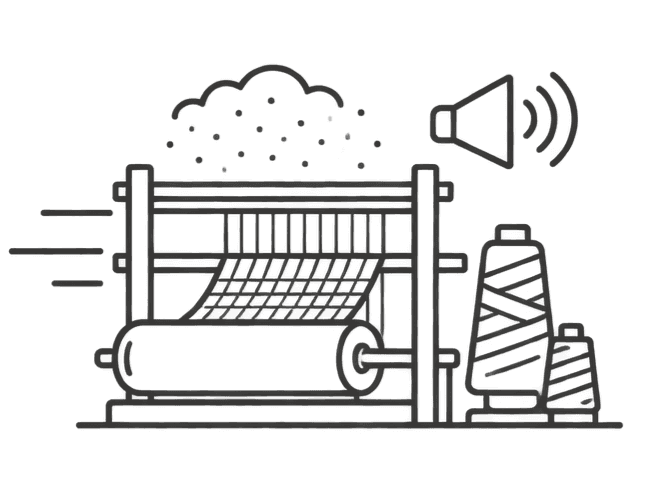
Blowroom, carding and ring-frame crews breathe respirable cotton dust every shift, and weaving sheds run above the noise limit for the whole of it. Byssinosis is characteristically worse on the first working day after a break — which is precisely why the spirometry has to be timed, not simply performed.
34
Textile units under contract
First-shift
Spirometry timing for byssinosis
48h
Report turnaround
Primary hazard
Cotton dust & loom noise
Byssinosis screening and hearing conservation
The hazards below drive every test in the textile protocol. Nothing is included because it is standard — each one answers a specific exposure.
Blowroom, carding and combing operations release fine vegetable dust that drives byssinosis and chronic airflow obstruction, detectable on spirometry well before a worker reports chest tightness.
Weaving sheds routinely sustain levels above 85 dB(A) across the shift, making pure-tone audiometry and hearing conservation a statutory obligation rather than a courtesy.
Humidification plants hold spinning halls at high moisture to protect yarn quality; the same conditions raise heat-strain and cardiovascular risk for the people working in them.
Reactive dyes, bleaching agents and formaldehyde-based finishes contact skin and airway, driving dermatological and respiratory surveillance in the wet-processing house.
This is the panel an inspector will ask you to justify. Every row states the exposure it answers and the cycle it runs on.
| Test | Why it is in the panel | Frequency |
|---|---|---|
| Spirometry (PFT) | Byssinosis and airflow obstruction | Annual, first shift back |
| Chest radiograph | Chronic dust-related change | Annual |
| Audiometry | Loom and frame noise above 85 dB(A) | Annual |
| Complete blood count | General haematological baseline | Annual |
| Vision screening | Close inspection and defect grading work | Annual |
| ECG and blood pressure | Heat and humidity cardiac load | Annual |
We prepare the registers and evidence in these formats as part of the programme — not as an add-on when an inspection is announced.
Factories Act 1948 — Third Schedule, byssinosis as a notifiable occupational disease
Cotton-dust exposure monitoring and periodic medical examination of dust-exposed workers
Noise-induced hearing loss surveillance with hearing conservation records
Fitness certification retained and produced for the Inspectorate of Factories
Share your workforce profile and receive a written proposal within 48 hours — protocol design, plant-wise scope, camp schedule and commercials, reviewed by an occupational physician.